
Arc Damage Modeling Tool
Summary of Arc Damage Modeling Tool
- Based on over 3,000 arc damage assessment tests, the Arc Damage Modeling Tool (ADMT) is the state-of-the-art for wire failure damage assessment
- The ADMT is capable of predicting the damage to both direct electrical arcing (direct contact) and indirect arcing (damage from the arc plume)
- Data generated can be used for EWIS certification to requirements such as 25.1707 and 25.1709
Introduction to the Lectromec Arc Damage Modeling Tool
The Arc Damage Modeling Tool (ADMT), developed in 2006 by Lectromec in coordination with the Federal Aviation Administration (FAA) Technical Center, simulates electrical arcing event damage. For mission or safety critical systems utilizing high density power routing (either large wire bundles or high amperage), an electrical arcing failure can create unsafe operating conditions.
This tool, developed based on quantifying the energy released in the arc, can predict the level of damage depending on circuit and material parameters. While electrical arcing and the subsequent damage have been a concern to the aviation industry for many years, this tool is the first attempt to develop a software tool that can model the damage and provide predictive analysis.
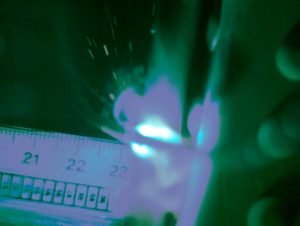
ADMT Focus
The ADMT program was designed to achieve five main goals:
- Provide a fundamental understanding of how damage occurs by quantifying the energy in the arc
- Supplement and extend test data throughout the range of test parameters
- Provide insight into how variation in test parameters will affect levels of damage
- Show how mitigation techniques such as protective sleeving or increased separation distance will affect arcing damage
- Use the results of the project to provide data and certification, in particular for FAR 25.1709 requirements compliance
The ADMT is built upon many months of testing performed both by Lectromec and the FAA Tech Center. These tests were performed on a wide range of parameters that included varying power sources and voltages (including 270VDC) and different circuit/bundle protection schemes. The variation in test configurations provides a wide range of underlying information that ADMT assessment supports. The complex nature of arcing events results in non-linear responses to simple changes such as available current, separation distances, and various aerospace materials.
The ADMT has been integrated into the larger Electrical Wire Interconnection Systems Risk Assessment Tool (EWIS RAT™) and will provide more robust damage analysis capabilities to the extensive risk assessment technologies pioneered by Lectromec in the EWIS RAT™.
Case Study
During work on an aircraft OEM, the ADMT was identified by the customer as a necessary part of their aircraft certification package. In addition to the physical testing, the ADMT would support (or reject) the lab results and provide greater confidence in the safe separation distances used by the OEM engineers when designing the aircraft’s EWIS.
The lab data was then taken and inputted into the ADMT. The simulation parameters evolved to best match the available test data until a close match was found with the simulation and available test data. Since the ADMT is able to provide a much higher resolution of information about the objects under tests, it was then possible to determine the maximum temperature for the components.
Many of the tests results and safe separation distances were confirmed with the ADMT. However, several cases were identified that questioned the separation distance (i.e. too high a maximum temperature). Additional ADMT work also identified the likely worst case scenario (using assumptions based on Lectromec’s knowledge and experience with wire failure) and the impacts on nearby systems. This resulted in increasing the separation distance for the identified areas and performing additional testing to confirm the results.
Further Reading
Additional documents and articles about the ADMT and application can be found below