
NAVAIR QPL Qualification: A Plain-English Guide for EWIS Component Manufacturers
Standard parts rely on a consistent standard with consistent administration of the parts, suppliers, and processes. For manufacturers of aerospace wire, cable, connectors, contacts, splices, terminals, sleeving, tools, clamps, and related electrical interconnect components, qualification through the NAVAIR Qualified Products List (QPL) process can seem daunting. The process is formal, well-defined, and document-heavy, but it is not mysterious once the pieces are separated. In this article, we review the objectives of the QPL process, the process itself, and what the QPL is not.
Overview
At its core, component qualification is an independent part and system review process. Every aerospace part is examined and tested against the applicable military, federal, or non-government standard before acceptance, and occasionally before acquisition is made for a larger program. Specifically regarding the NAVAIR QPL process, once the product qualifies, it can be listed on the appropriate Qualified Products List Supplemental Information Sheet (QPL-SIS) and reflected in the Qualified Products Database (QPD), which is used for U.S. government procurement. NAVAIR's QPL Group at Patuxent River manages electrical interconnect QPL activity for a large set of aerospace wiring component specifications used in defense projects.
It should be made clear that a QPL listing is not a marketing badge earned by self-declaration. It is a controlled status tied to a specific product, specification, manufacturing location, material set, process, and quality system. Once a product is qualified, the manufacturer must continue building it the same way, at the same location, and with the same equipment unless the qualifying activity approves a change. The distinction between a minor and a major change continues to be discussed in SAE committees.
Start With the Right Specification
Testing is not the first step. The first step is identifying the exact specification and detail specification sheet, often called a slash sheet (for example, AS22759/34), that applies to the product. A QPL can exist only where the governing specification requires qualification and identifies the requirements for examination, testing, and retention. For NAVAIR's electrical interconnect work, many of these documents are formerly government standards that transitioned to management under SAE aerospace committees, with NAVAIR serving as the qualifying activity.
Before contacting NAVAIR to express intent to seek qualification, the product manufacturer should confirm the current revision of the specification, the detail sheets, the product type, class, size, style, material system, and part numbers to be qualified. The manufacturer also needs an active Commercial and Government Entity (CAGE) code for each listed manufacturing facility.
This is one place Lectromec can provide early support. A pre-application review can map the product against the specification, flag missing test capabilities or documentation, and separate qualification requirements from product-development questions.
Similarity
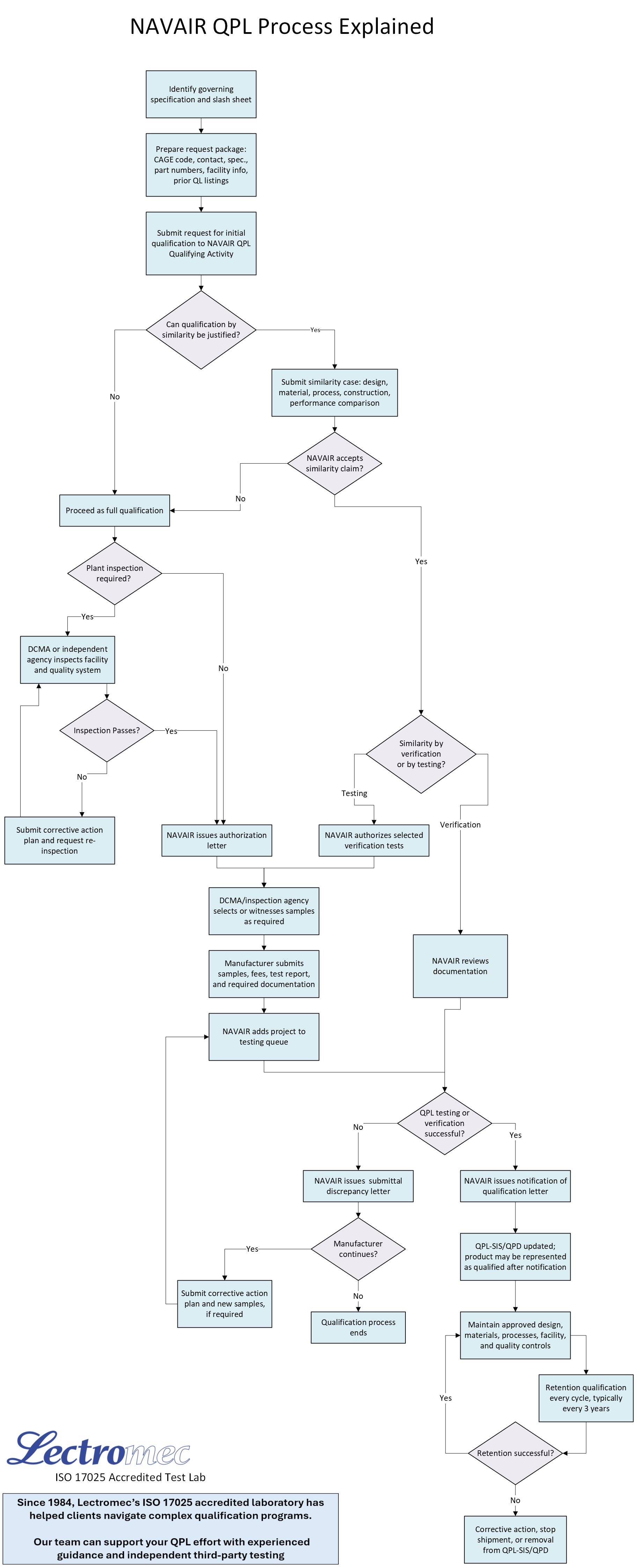
The NAVAIR QPL process guide describes two initial qualification routes: with similarity and without similarity.
Similarity may be available when the product or product family shares common traits with another product from the same manufacturer that is already listed or under evaluation. The claim must be based on material, process, design, construction, and performance requirements. Minor design or process changes may support a similarity path. A new family or significant engineering or process change generally does not. One example where this is explicitly defined is AS22759: AS22759/34 shares a similarity group with /35, /41-/43, and /56-/57. The wires in this similarity group share common insulation types and insulation wall thicknesses (all are normal-weight constructions) but differ in conductor type.
There are two practical forms of similarity:
- Similarity by verification: NAVAIR may review drawings and documentation without requiring sample testing.
- Similarity by testing: The manufacturer submits samples for a defined subset of tests selected by NAVAIR.
In either case, NAVAIR performs the review and determines whether the claim is valid. If similarity does not apply, the manufacturer follows the full initial qualification route. That path is more involved and may include a plant inspection before testing is authorized, especially if the manufacturer is not already listed on a QPL-SIS.
Request Before Testing
At the start of the engagement, a manufacturer sends NAVAIR a request for initial qualification. The request should include the manufacturer's information and the specific qualification request. This request frames the product, facility, and intended qualification route. If the product may qualify by similarity to an existing qualified part, the manufacturer should provide evidence supporting the claim. Without similarity, the initial request should give NAVAIR enough information to decide whether a plant inspection is needed and what testing path should be authorized.
Manufacturers should not start qualification testing before NAVAIR issues written authorization. It can still be advantageous to prototype the product and run selected high-risk development tests before the formal program. Those tests vary by product, but they should focus on:
- Key properties: Many tests rely on certain key product qualities. Focus on the more severe tests and those that best quantify the performance of a key property.
- Historical issues: Some products have well-established failure modes associated with poor quality. Development testing should verify that the product does not present those issues.
- Technical challenges: Novel products may have requirements that are traditionally difficult to achieve. Testing should verify that the product can meet those unique performance requirements.
Whether any pre-testing is performed or not, the authorization letter is the control document for the formal test program. It identifies the tests, due dates, oversight requirements, sample submittals, fees, and addresses.
Plant Inspection and Sample Control
When required, the manufacturer's plant inspection focuses on whether the manufacturer has the equipment and process controls necessary to repeatedly produce conforming products under controlled conditions. The NAVAIR process guide describes the areas reviewed:
- Quality program effectiveness
- Current specifications and drawings
- Documented manufacturing operations
- Test methods
- Inspection instructions
- Calibration
- Process control
- Purchasing controls
- Nonconforming material control
The Defense Contract Management Agency (DCMA) or an independent inspection agency may perform or support the inspection. For qualification and retention submittals, the inspection agency may also:
- Select, mark, or certify samples
- Monitor required manufacturer testing
- Witness designated tests
- Endorse the Qualification Test Record
Manufacturers often benefit from a readiness assessment before the formal visit. Are procedures current? Is equipment calibrated? Are sample lots traceable? Are records complete? Can the team explain how submitted samples represent normal production?
Testing
After authorization, the next stage is testing. Depending on the agreement, product type, capabilities, or risk, test performance may be split between the manufacturer and NAVAIR. Manufacturer-performed tests must be completed at a laboratory recognized or certified by NAVAIR. Proper test performance is always important, and NAVAIR may reject poorly documented or improperly conducted tests.
The manufacturer then submits the required samples, fees, test report, data, and documentation according to the authorization letter. From the NAVAIR perspective, a project is not placed into the testing queue until fees and samples have been received. Because of the critical nature of NAVAIR's work and the volume of products being qualified, NAVAIR notes in its FAQs that new qualification may take up to six months or longer. Once full payment and samples are received, testing generally should be completed within six to eight weeks.
If testing or verification is successful, NAVAIR issues a notification of qualification letter and updates the QPL-SIS/QPD process. The manufacturer should be careful when making a formal announcement or shipping the product: the NAVAIR QPL guide states that the manufacturer is not qualified and cannot advertise or ship products as qualified until the notification letter is received.
If the submittal is not successful—for example, if one or more tests identify performance issues—NAVAIR will issue a qualification submittal discrepancy letter. The manufacturer can prepare a corrective action plan and submit new samples for retest or end the process because of changing market conditions, excessive technical issues, or other business factors.
Lectromec has supported numerous qualification test efforts with our ISO 17025 accredited lab data providing supporting evidence of product compliance. Manufacturers can review Lectromec's available capabilities in our test catalog.
Retention
Nothing lasts forever, and qualification is not permanent. NAVAIR's QPL guide states that retention qualification is required every three years to ensure the continued integrity of the qualification status. The manufacturer is responsible for providing samples for retention testing that demonstrate its continued ability to meet the governing specification. That said, the QPL system is voluntary, and a manufacturer is under no commitment to produce QPL products or continue with NAVAIR qualification.
If the manufacturer decides to continue, the retention process normally starts when NAVAIR sends a request for samples. That begins coordination with DCMA or the independent inspection agency, submission of the required samples and fees, and NAVAIR evaluation and testing. If NAVAIR is delayed in sending the letter, the FAQ says the supplier is still considered qualified until removed and should wait for authorization before starting retention testing.
Some limited situations allow retention by certification. This option is available only when allowed by the specification or as directed by NAVAIR, and the NAVAIR QPL guide indicates it is available only once. In that process, the manufacturer submits untested samples, quality conformance data, and required certifications rather than completing the normal retention test route.
Minor and Major Changes
The biggest QPL risk is often not the initial test; it is uncontrolled change after approval. Product design, material, part number, manufacturing process, quality conformance changes, ownership changes, and plant moves must be reported to NAVAIR. Plant moves must be reported before and after the move, and a new plant inspection will be required. Failure to notify NAVAIR can lead to a stop in shipment or removal from the QPL.
Advertising is also controlled. A company may not claim or imply QPL status before approval, suggest government endorsement, or claim to be the only qualified source when that is not true. Removal can also result from missed retention, unresolved failures, major audit nonconformances, failure to report Government-Industry Data Exchange Program (GIDEP) issues, terminated manufacturing, or inability to implement an acceptable corrective action plan.
What QPL Is Not
For those looking to use products listed on the QPL, it is important to recognize a key part of the system: the NAVAIR QPL process is a qualification process, not a day-to-day quality control process. NAVAIR's actions are critical to the aerospace industry and help reduce EWIS product issues. However, outside qualification and requalification, NAVAIR does not have insight into the quality of every product produced each day.
Production, shipping, storage, distribution, rebranding, handling, and installation issues can still occur. Monitoring supplier quality, sampling products, and following a "trust but verify" approach are necessary to ensure high-quality products are installed on platforms. The sampling rate, test types, and permissible variability should be defined within the component buyer's quality control program.
Conclusion
The cleanest way through NAVAIR QPL qualification is to treat it as a lifecycle program, not a one-time lab activity. It starts with defining the requirements correctly, building the evidence package before asking for authorization, maintaining tight sample control, completing the authorized testing, and preserving change discipline after approval.